
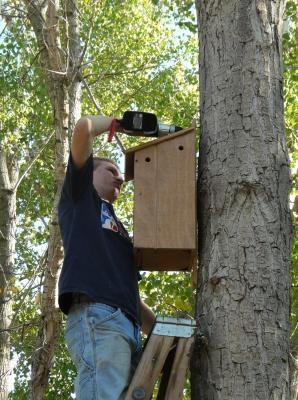
Deliberate actions to enhance shelter on privately owned land can provide benefit for a wide variety of wildlife. Nesting structure installation, snag creation, and brush pile construction can all provide opportunities to enhance habitat for birds, amphibians, reptiles, mammals, and insects. Careful planning, installation, and management of these shelters can help to meet a landowner’s wildlife objectives whether that be increasing Wood Duck use of the property, providing cover for rabbits, or improving den availability for woodpeckers. The following items will be considered when developing a Wildlife Habitat Conservation Agreement (WHCA) which includes Supplemental Shelter as a qualifying management activity for the Wildlife Reserve Land criterion.
Supplemental Shelter must be a man-made feature. Existing snags do not meet the qualification for this activity.
Supplemental Shelter can offer a critical habitat component for those species that require cavities or dense cover. Details associated with design and installation can be vital to ensure these shelters are useful during the life of the WHCA. In addition to recording management activities in the effort log, it is suggested that progress be documented with photos.
Supplemental Shelter Options
Nesting structures come in a wide variety of sizes, materials, and designs, and while most species of cavity dwelling wildlife will opportunistically use any available cavity regardless of specification, some designs favor a specific species or suite of species— even a simple “bird house” can be tailored to better fit a chickadee over a barn owl. In most instances nesting structures should be installed on a free-standing pole or post, and a predator guard is required. Surrounding vegetation must be managed to limit accessibility by predators such as raccoon and rat snakes. Annual maintenance of wildlife nesting structures is required to ensure they are in good usable condition. Installation, maintenance, and animal use of the structure must be recorded on the Supplemental Shelter effort log.
Snags are standing dead trees which provide important nesting, denning, and feeding sites for a wide variety of species. Lightning strikes, disease, insects, old age, and drought kills trees naturally, yet snags are often still a limiting factor for habitat in our forests. Snags can be artificially created by either girdling trees or through hack and squirt herbicide application techniques. When creating snags in a forested stand, select trees 10 inches or larger in diameter to promote longevity. Avoid killing living trees with hollows or dens present as these already provide excellent cavities. When possible, avoid killing oaks, persimmons, hickories, blackgum, and other important mast producing trees. Use caution if killing pine trees for snags. The injured or dying pine trees may attract pests which could damage nearby production-oriented stands. All snags created as part of the WHCA must be marked with a 4-inch-wide band of paint for future identification.
Brush piles offer dense cover which can play a key role in the surrounding ecosystem. Invertebrates often use the decaying woody material as a food source or a site for egg laying. The invertebrates serve as a food source for lizards, toads, or snakes which then can serve as food for birds of prey or predatory mammals. Initial construction of a brush pile should be well thought out to ensure usefulness and longevity. Larger logs should be used as the base for the pile with smaller logs and branches placed on top. Woody material will need to be added to the piles periodically to account for decay and decomposition. Like brush piles, rock piles can meet the intent of Supplemental Shelter if size, shape and spacing of rocks allows for access by animals. Installation, maintenance, and animal use of brush, or rock, piles must be recorded on the Supplemental Shelter effort log.