
There are numerous requirements relating to both land ownership and land use listed in the Wildlife Conservation Land Program Legislation (G.S. 105-277.15), and landowners interested in the program should reference this statute for specific language. The most important requirements are outlined below.
Requirements for Participation
Wildlife conservation land must consist of at least 20 contiguous qualifying acres under the same deeded ownership and managed according to a written Wildlife Habitat Conservation Agreement (WHCA) between the landowner and the NC Wildlife Resources Commission (NCWRC). The total acreage enrolled in the WCLP cannot exceed 1,000 acres per landowner per county. Up to 200 acres of an owner’s land in each county may be classified as wildlife conservation land under any combination of land use criteria 1 or 2 defined below. A maximum of 800 acres of an owner’s land in each county may be classified as wildlife conservation land under land use criterion 3 defined below.
Once the initial qualifying tract of 20 contiguous acres is enrolled, additional non-contiguous land may be enrolled as a “satellite area.” Satellite areas may be on the same or different tax parcel as the initial qualifying tract. However, all satellite areas must be deeded to the same owner(s) as the initial tract, be one or more acres in size, and meet all other WCLP ownership and land use requirements. If the satellite tract is enrolled under criterion 2, wildlife habitat protection, the additional acreage must be located in the same county as the initially qualifying 20-acre tract.
The statute specifies that wildlife conservation land must be managed under a written WHCA with NCWRC. NCWRC staff biologists are available to assist landowners with completion of the agreement and NCWRC approval of the WHCA is required prior to submission to the county tax assessor’s office. Upon approval of the WHCA, the landowner must make application to the county to request their property be assessed as wildlife conservation lands. The County Tax Assessor will determine if the land qualifies for assessment at a reduced value. The agreement must be entered into prior to January 1 of the year for which the benefit is claimed or within 60 days following an ownership transfer. Qualifying land must be managed under a WHCA with the NCWRC that meets one or more of the following land use criteria:
Criterion 1 - Land used for the protection of a wildlife species listed in NCAC 10I.0100
The first criterion is met if one or more protected wildlife species lives on the land and the landowner agrees to manage the land to protect the species. Qualifying wildlife species are those designated by the NCWRC as endangered, threatened, or special concern.
The term or phrase “lives on the land” means that a qualifying wildlife species has been identified on the land at the time the WHCA is executed, and the deferment is applied for. Furthermore, and the term “protect” means that the species is not only protected from direct mortality and harassment, but also promoted through appropriate land management strategies. Observation of a species does not automatically qualify a property as wildlife conservation land. Demonstrable evidence must be presented that the species lives on the land, and habitat management strategies must be implemented that provide for the sustainability of the species on the enrolled property. For migratory species, the land must provide breeding, wintering, or foraging habitat.
Criterion 2 - Land used to conserve priority wildlife habitats identified in G.S. 105-277.15
The second criterion is met if the landowner conserves one or more priority wildlife habitats identified in the NC Wildlife Action Plan. The qualifying habitats are listed below and described in the Wildlife Conservation Land Program Priority Habitat Management Guideline documents. The term "conserve" means to manage for the sustained wildlife benefits of one or more of the below priority habitat types as specified in a written WHCA. The delineated priority habitat may include an area of influence, or buffer, surrounding a specific habitat feature if that land is essential to, and managed for, the conservation for the qualifying habitat type. Conservation does not preclude some human uses of the land; however, compatible uses must be addressed in the WHCA and cannot degrade the quality of the priority habitat.
Criterion 3 - Land dedicated as a Wildlife Reserve and managed as required in
The third criterion is met if the landowner manages their land as Wildlife Reserve Land, which is actively and regularly used as a reserve for hunting, fishing, shooting, wildlife observation, or wildlife activities; upon which wildlife management activities are conducted to ensure the propagation of a sustaining breeding, migrating, or wintering population of native wild animals. Land primarily maintained for other uses such as lawns, livestock pastures, golf courses, solar arrays or land primarily managed for financial gain through forest or agriculture commodity production will generally not qualify as Wildlife Reserve Land. The landowner must maintain three or more of the following seven management activities as agreed upon in the WHCA, see additional information by topic in the accordians below.
All acreage included in a WHCA, and used to meet minimum acreage requirements, must be deeded to the same grantee(s). Qualifying land ownership include individuals, family business entities (publicly traded corporations are not eligible), family trusts, or a combination of one or more of these three entities as tenants in common. The land must have been deeded to the same owner for the previous four years, unless one of the following conditions exists.
- If the land is the owner's place of residence, then it meets the ownership tenure requirement.
- If an owner of land enrolled as wildlife conservation land acquires additional parcels which share a common boundary with the enrolled land, then the newly acquired tract meets the ownership tenure requirement.
- If the land is owned by a family business, and at least one of the business members have owned the land for the past four years then the ownership tenure is met.
- If the land is owned by a family trust, and at least one of the current trustees have owned the land for the past four years, then the ownership tenure is met.
- If land classified as wildlife conservation land changes ownership and the new owner signs the WHCA in effect for the property, continues to use the land as wildlife conservation land, files a WCLP application with the county assessor within 60 days of acquiring the property, and meets all other ownership requirements then classification as wildlife conservation land may be retained by the new owner.
- If the land is owned by tenants in common, the land meets all other ownership requirements, and the land was owned by one or more of the tenants for the past four years, then the ownership tenure is met.
- If the land is acquired through transfer or inheritance from a relative, the new owner meets all other ownership requirement, and the land was owned by the relative for the past four years, then the ownership tenure is met.
If the land loses its eligibility for the deferment, is found to be in violation with the WHCA or is voluntarily removed from the program a financial penalty will be levied by the county tax collector. This payment is calculated based on the value of the deferment for the previous three years and an applicable interest penalty. Deferred taxes are not due in special circumstances as provided in G.S. 105-277.15(g)(1) and 105-277.15(g)(2).
Land enrolled in the WCLP under criterion 3 must be inspected by a certified wildlife biologist, or qualified NCWRC staff person, at least once every five years to ensure the WHCA is being followed, at least three of the seven qualifying management activities are maintained, and the WHCA is updated as needed. The landowner must keep a log of actions conducted to install and/or maintain management activities as well as other supporting documents as evidence that selected practices were maintained over the five-year period. A county tax office may request a NCWRC biologist visit any property enrolled in the WCLP to confirm the WHCA is being followed and management is appropriately documented.

Steps to Enroll
Review information on this webpage to determine if your property is eligible for the WCLP.
Discuss the WCLP with co-owners or others who influence decisions for the property. Consider which WCLP criteria may fit the property and the level of management you are willing to implement.
A NCWRC biologist will contact you to discuss program details and determine the next steps in developing the required WHCA.
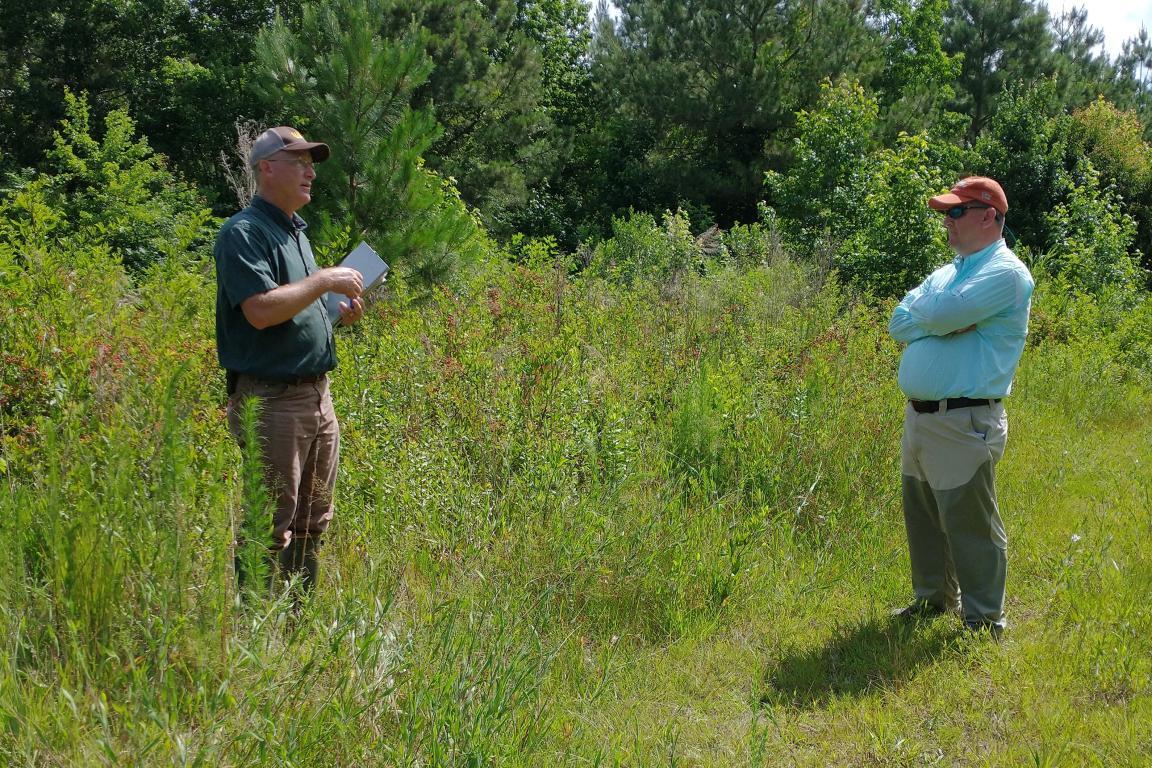
Schedule a site visit with the NCWRC biologist. During this visit you will inspect the property together and identify management practices that qualify for the WCLP and meet your specified wildlife objectives for the property.
The biologist will draft a WHCA for the property based on your input. You should review the WHCA with others that have a vested interest in the property before final signatures are obtained. Keep in mind failure to follow the WHCA can result in a financial penalty.
Prior to applying for the WCLP with the county tax office, you must sign the WHCA and provide a signed copy to the NCWRC biologist.
To apply for the WCLP you must submit a fully signed copy of the WHCA and a completed NC Department of Revenue AV-56 form to the county tax office during their open enrollment period. Open enrollment is usually during January each year but should be confirmed with your county tax office. If you have purchased or inherited a tract of land previously enrolled in the WCLP, you must submit an updated WHCA and AV-56 to the local tax office within 60 days following deed transfer.
The county tax office will make the final determination concerning enrollment in the WCLP and adjust property tax valuation based on the qualifying WCLP criteria.
You must adhere to and document the management activities as specified in the WHCA. Failure to do so may result in a determination that you are out of compliance with WCLP regulations, which could result in a financial penalty levied by the county tax office. If you are unable to meet the obligations of the WHCA, contact your primary NCWRC representative as soon as possible.

Frequently Asked Questions
The WCLP and PUV both offer property tax deferments but are separate programs with different goals. Any given acre can only be enrolled in one of these programs.
T&E plant species do not qualify under Criterion 1, but the land may qualify under another WCLP criterion.
A landowner must have at least 20 contiguous acres that meet the qualifying criteria, not just 20 acres of land. Homesites, developed areas, lawns, and acreage managed for agriculture or forestry production are not considered eligible for the WCLP. Once the initial 20-acre minimum is met, smaller, disjunct areas can be considered for “satellite enrollment.”
Reach out to your local NCWRC biologist and submit an application for assistance as early in the calendar year as possible. New habitat agreements must be approved and signed before Dec. 31st to be considered for the following tax year. Applications for NCWRC assistance are addressed in the order received. While NCWRC does prioritize applications received prior to October 1st, completion of an agreement within the current calendar year is dependent on the order the application is received and the number of pending requests in the associated NCWRC district. Habitat agreements transferred to a new owner must be approved, signed, and submitted to the local tax assessor’s office within 60 days of deed transfer.
For additional information on the WCLP or to schedule a site visit, contact the Wildlife Conservation Biologist who serves your area.
The method of calculating tax deferment valuations may vary from county to county. In general, deferred values are based on soil productivity related to agriculture or forestry commodities. Contact your local tax assessor’s office for specific details on WCLP deferment valuations.