
North Carolina hosts a wide variety of unique ecosystems, and each of these natural communities serve as habitat for specific species of plants and animals. Habitat Control is the management of vegetation to benefit native wildlife species. The careful management of habitat on private lands not only can meet a landowner’s objectives for their property but will likely benefit migratory species and wildlife living nearby.
To qualify as Wildlife Reserve Land a Wildlife Habitat Conservation Agreement (WHCA) must include Habitat Control. Habitat Control activities must address the management of all acres which are not encompassed within Supplemental Food or Supplemental Water areas.
Management treatments include the mechanical, physical, or chemical manipulation of vegetation to achieve desired conditions. The varied nature of habitats and the practices implemented to improve habitat conditions, requires the WHCA include details on current stand conditions, prescribed treatments, desired conditions, and the species which will benefit from management. The following are a few common practices, that may be incorporated in a WHCA.
Methods for Habitat Control
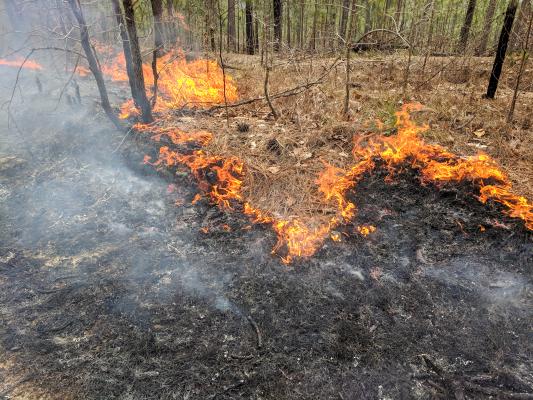
Prescribed burning mimics historic fire that shaped the natural communities of North Carolina. These fires were ignited by Native Americans or lightning. Today prescribed burns are conducted in forested and open areas to promote diverse plant communities. Contractors can be hired to conduct burns and Prescribed Burn Associations can help landowners gain experience conducting prescribed burns.
Forest stand improvement practices are implemented to modify the structure and composition of forests. Specific recommendations will depend on current and desired conditions. Crop tree release is used to remove competition from around desirable trees. With less competition the crop trees will produce more mast (fruits and nuts) for consumption by wildlife. Canopy gaps can be installed to allow more sunlight to reach the forest floor. More sunlight will encourage growth of the understory, increasing browse and improving nesting structure in the stand. Edge feathering and daylighting roads removes trees from along fields and roadways to promote species and structural diversity. These linear strips of brushy vegetation improve nesting structure and serve as travel corridors. Forest thinnings reduce the overall tree density, promoting understory diversity and vigor. Depending on stand conditions a thinning may produce economic revenue. All commercial harvest on WHCA acres require prior approval by North Carolina Wildlife Resources Commission (NCWRC).
Early succession is a priority habitat in North Carolina. This habitat type is dominated by herbaceous plants with limited woody vegetation. Disturbance such as fire, grazing, disking, herbicide application, or mowing is required to maintain this stage of succession.
Herbicide application can be a critical tool to manage wildlife habitat. The goal of an herbicide application is to control undesirable plants and promote desirable vegetation. To effectively achieve this goal herbicides should be applied in a selective manner. Targeting specific plants, or groups of plants, with a precise application method, such as spot treatment, offers selectivity. Selectivity can also be realized by utilizing an herbicide formulated to kill the targeted plant, yet spare desirable species. Timing of application can further improve selectivity. Greatest selectivity is achieved when selective herbicide formulations are applied using selective application methods at an appropriate time. All herbicides must be applied according to the product label –THE LABEL IS THE LAW!
Invasive plants can spread quickly and cause harm to local ecosystems. These non-native species can outcompete native species, degrading native plant communities and habitat quality. To reduce negative impacts, invasive species should be treated to limit their establishment and spread. Early Detection and Rapid Response (EDRR) is the most effective approach to address invasive species. Habitat Control includes a wide variety of management practices. A few options are mentioned above, but others may be prescribed as part of WHCA. Details outlined in the WHCA must be closely adhered to and implementation must be recorded in the Habitat Control activity log. It is suggested that progress be documented with photos as well.