
Striped Bass Fishing Information
The N.C. Wildlife Resources Commission (NCWRC) has approved a temporary rule amendment and issued a proclamation to open the season for harvesting striped bass by hook-and-line in sections of the Tar-Pamlico River and Neuse River from April 1 through April 30, 2026. The N. C. Division of Marine Fisheries also issued a proclamation to open a similar striped bass harvest season in waters under their jurisdiction.
The area open to harvest includes the Inland and Coastal Fishing waters of the Tar-Pamlico River and its tributaries upstream of a line between Gum Point near Mixon Creek and Fork Point near Durham Creek, both in Beaufort County, and the Inland, Joint and Coastal Fishing waters of the Neuse River and its tributaries upstream of a line between Cooper Point near Goose Creek in Pamlico County and Fisher Landing Point in Craven County.
The daily creel limit is one fish per angler. The minimum length limit for striped bass and hybrid striped bass harvested during the 2026 open season is 18 inches (total length) and no fish between 22 and 27 inches (total length) may be taken or possessed. Click here for more information on how to properly measure a fish.
State law requires mandatory reporting of striped bass harvested during this season. More information can be found on the Mandatory Harvest Reporting webpage.
As of 2026, the striped bass harvest season is currently closed by proclamation in the Roanoke River and is closed by rule in the Cape Fear River and its tributaries. All striped bass caught in waters without open seasons must be released immediately.
Striped Bass Catch and Release Guide
You can aid the survival of released striped bass (rockfish) with careful planning, fishing and handling methods. Hooked stripers can die from injury or from the stress of being hooked, fought and landed. Stress-related mortality increases greatly when water temperatures exceed 70F and is also greater in freshwater than in brackish water. Infection and disease can result in mortality of fish whose protective slime coat is removed during handling. The chances that released fish will survive will be increased greatly by following these guidelines. Ideally, fish are landed quickly, handled little, if at all, and kept in the water while the hook is removed using a dehooker.
Learn and practice catch-and-release fishing techniques and teach them to your children and friends.
- Know the fishing regulations and be prepared to release fish.
- If you are planning a catch-and-release fishing trip for stripers, do so in early spring, late fall or winter when water is less than 70F.
- Use strong enough tackle and land fish quickly to minimize stress.
- Use barbless hooks or bend down the barbs on regular hooks to release fish quickly.
- Use artificial lures instead of live bait to reduce deep hooking.
- Replace treble hooks with large, single barbless hooks to reduce injury and handling.
- If legal, keep fish that are bleeding heavily as their chances of survival are poor.
- Keep the amount of handling to a minimum and keep fish in the water if at all possible.
- Use landing nets only when necessary and these nets should be made of knotless nylon or rubber.
- Do not allow the fish to thrash around. If you must handle it use wet gloves or a wet rag. Stripers can be calmed down by covering their eyes and/or turning them on their back.
- A fish that does not swim away can be resuscitated by moving it back and forth to force water through its gills
- Carefully, but quickly, remove hooks using a dehooker, needlenose pliers or forceps.
- Whenever possible remove hooks in the throat or gut using a dehooker.
- Cut the line if you cannot carefully or quickly remove hooks.
Report Tagged Bass
Coastal river anglers who catch a striped bass with a red or yellow tag during their fishing trips can participate in research projects that help fisheries biologists manage North Carolina’s striped bass populations. N.C. Wildlife Resources Commission biologists are cooperating with researchers from N.C. Division of Marine Fisheries on studies to determine striped bass movement throughout North Carolina’s coastal waters and to estimate mortality rates of the state’s striped bass populations. The striped bass collected in these projects are tagged with red or yellow tags, which are printed with a unique number and contact information for the project. Please click here for more information on the NCDMF Tagging Program.
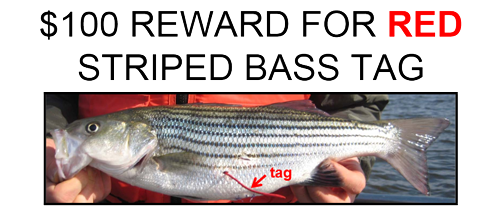
REPORT a RED Tagged Striped Bass
- Cut the tag for $100 reward and prepare to report tag with related catch information.
- For red tags with NCDMF in text:
- Call 1-800-682-2632 or click here to report the tag online.
- Please leave your name and phone number if you reach a recording. Your call is very important and will be returned.
REPORT a YELLOW Tagged Striped Bass
- Cut the tag and prepare to report the tag number and catch information.
- Call 1-800-682-2632 or click here to report the tag online.
- Reward: $5, hat, or fishing towel.
- Please leave your name and phone number if you reach a recording. Your call is very important and will be returned.
The tags are located in the abdominal area of striped bass, most often behind the left pectoral fin. Check both sides of the fish for tags; cut and report all tags observed.
