
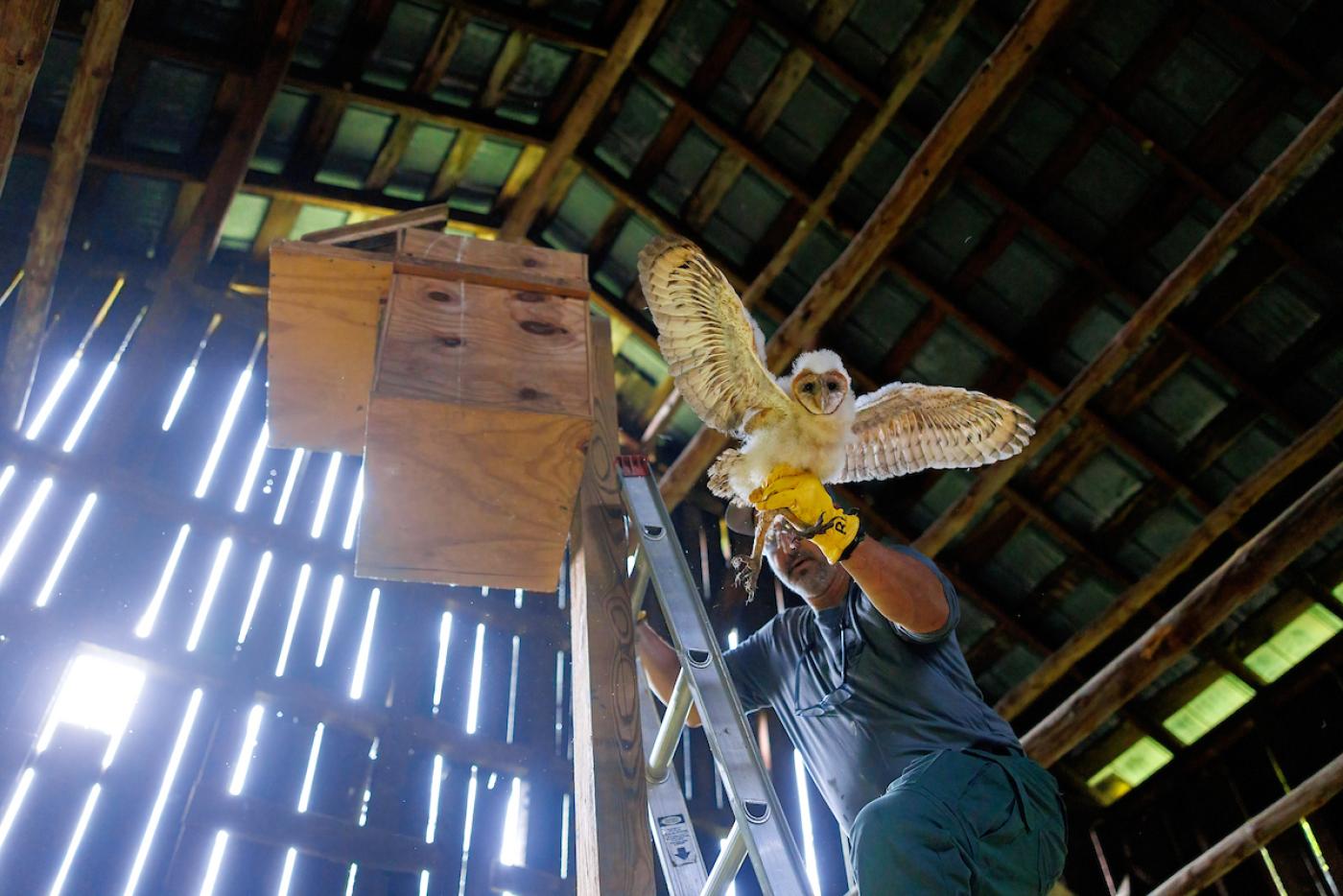
Springtime is birthing season for many wildlife species. This spring, over 62,000 people watched and listened remotely as the first of six barn owl eggs hatched in real-time via an N.C. Wildlife Resources Commission's (NCWRC) live web camera, affectionally called the “Owl Cam.”
“We have folks who have watched from almost every state, as well as Canada, Switzerland, Germany, UK, France, Netherlands, Portugal, New Zealand, Italy, Estonia, Ireland, Argentina, Sweden, Spain and more,” said Wildlife Conservation Engagement Coordinator Austin Hill.
It’s the first time NCWRC has offered a live wildlife camera viewing opportunity to the public, and staff say it has exceeded expectations.
“Viewership hit its high point around April 15, when the owlets began hatching; truly the most exciting moment of the season,” said Education Division’s Development and Evaluation Supervisor Sydney Brown. “After that, things naturally quieted down as they settled into being adorable, little feathered lumps. But there is so much more to see! The owlets are learning to fly, testing their wings and getting into all kinds of antics. It’s the perfect time to tune in again. You won’t want to miss what happens next!”
NCWRC staff say over the next few weeks viewers will see the owlets losing the last of their baby down, start exploring and leaving the barn, and learning to hunt. As the owls fledge (learn to fly), viewers will see their clumsy failure attempts too.
“This is normal behavior. If they go to the ground and aren't able to fly back up, it's possible you may see them climb using their talons and beak,” said Hill.
Feeding the owlets continues to be a fan favorite. Since hatching, viewers have watched both parents bring food to the nest with delectables such as rodents and rabbits to feed multiple hungry owlet mouths.
There are three cameras inside and outside the nesting box. The public can click “Other Views” on the task bar to change camera angles.
“Cameras will become more active as the owls fledge and leave the box to explore the barn and surroundings,” said Hill. “The outside box cams allow us to be able to capture some unique behaviors not previously seen: an owlet teetering on the edge of a rafter, boosting itself into wobbly flight, or even downing a Southern flying squirrel. They'll stick around and continue to roost in the box or somewhere in the barn. It's also possible they will leave the barn and roost elsewhere. We'll continue to move the cameras around to provide the best viewing opportunities.”
The fledglings may leave the barn as early as July to start hunting on their own. Barn owls disperse singly in random directions in short moves, staying for a period before moving again in search of a territory. They could ultimately disperse hundreds of miles.
The female laid six eggs. One of the eggs never hatched, and on May 27 the youngest owlet died from what Commission staff believe was due to a combination of factors such as malnutrition, failure to thrive, competition from older siblings, drought-related prey shortages, and additional pressure from a nearby nest competing for the same food resources.
“The drought reduces prey availability for the owls. Plant life and vegetation die off which causes the rodent population to decrease,” said Hill. “A decreased rodent population means less food for the owls and more work to find the rodents that remain.”
There is no editing to the live camera, therefore when one of the owlets died, NCWRC posted information on the Owl Cam webpage about this being a natural part of life.
Staff are learning more about barn owls through this experience, too.
“We’ve never done anything like this before, so this has been our first real step into the live wildlife cam world, and we’ve been blown away by the public’s response. We’ve loved watching along with everyone else and have been gathering our own data on how barn owls’ nest grow and interact here in Western North Carolina. It’s been a wonderful journey, and we’re excited to do it again next year,” said Brown.
The project has garnered public interest in supporting this bird species.
“A lot of folks have emailed asking how they can help protect barn owls and how they can attract them to their property. Folks from all over the country are watching multiple hours a day and are fascinated by the behaviors they’re seeing,” said Hill.
This owl nest box was installed in 2011 at an undisclosed, remote location in Western North Carolina and used for agency monitoring. The idea of hosting a live webcam was created during an Education Division meeting while discussing opportunities to engage constituents.
The barn owl was chosen for this project because it is listed as a Species of Greatest Conservation Need (SGCN) Priority and a Knowledge Gap Research Priority by the agency’s 2025 Wildlife Action Plan.
“It allows us to see what happens in the nest of an elusive raptor and behaviors we wouldn't be able to observe on the outside of the box,” said Hill. “We're building out some K-12 Curriculum to go along with the camera so it can extend into the classroom.”
Viewers can identify each of the four owlets by their banded legs.
Once the owls have left the nest, staff will take the camera down for about a month, clean the nest box, make any needed repairs and check all the cameras and wiring. NCWRC will run the Owl Cam again next season and hope the same pair return next season.
Visit NCWRC’s Barn Owl webpage for more information. If interested in helping the agency learn how barn owls are doing across the state, please consider donating to our Wildlife Diversity Endowment Fund, which supports all species of greatest conservation need in North Carolina. In addition, the public can participate in data collection for this species by downloading the iNaturalist app and reporting barn out sightings.
The Barn Own Trust is another great resource to learn more about this species or how to find out if they have barn owl activity on their property.
“If people start seeing whitewash on the floor of their barn or silo, they probably have a barn owl roosting there – which is a good thing,” said Conservation Biologist Joe Tomcho. “Barn owls provide excellent natural rodent control, and the Trust also houses the blueprint for our own nest box design, which helps encourage a safe nesting site for these beneficial birds.”
To report an injured wild animal or to speak with a biologist, contact NCWRC’s Wildlife Helpline at 866-318-2401.