
Science is one of the world's top academic journals. That’s why N.C. Wildlife Resources Commission staff members are proud to have provided vital information for a recent peer-reviewed study Science published in Oct. 2026. It has literally flipped a previous belief about wildlife’s most “energy-efficient” form of transportation. The new data may help to learn more about future climate change impacts of migratory birds.
Prior to the study, swimming was ranked as the least costly mode for wild animals to travel, related to how much energy a species uses to get from one place to another. Flying was second. However, this study proves flying (called “flight costs”) actually requires less energy than swimming. When flying animals have access to natural atmospheric flows, they have free fuel from the sky. It is the first time the role of atmosphere in the movement of animals at a global scale has been studied. These findings offer a key to conservation and management of aerial species, a new framework for predicting the energetic cost of flight, and possibly insight into how climatic changes might affect where and when animals travel in the future.
“If atmospheric conditions change, so too will the cost of flight, and therefore how animals decide to migrate and establish communities,” says senior author Dr. Kamran Safi from Max Planck Institute of Animal Behavior.
The work combines 17 years of GPS and accelerometer tracking data from 850 birds and bats of 38 species. An international team of 68 researchers contributed data to the project, including the Commission’s Dr. Sara Schweitzer.
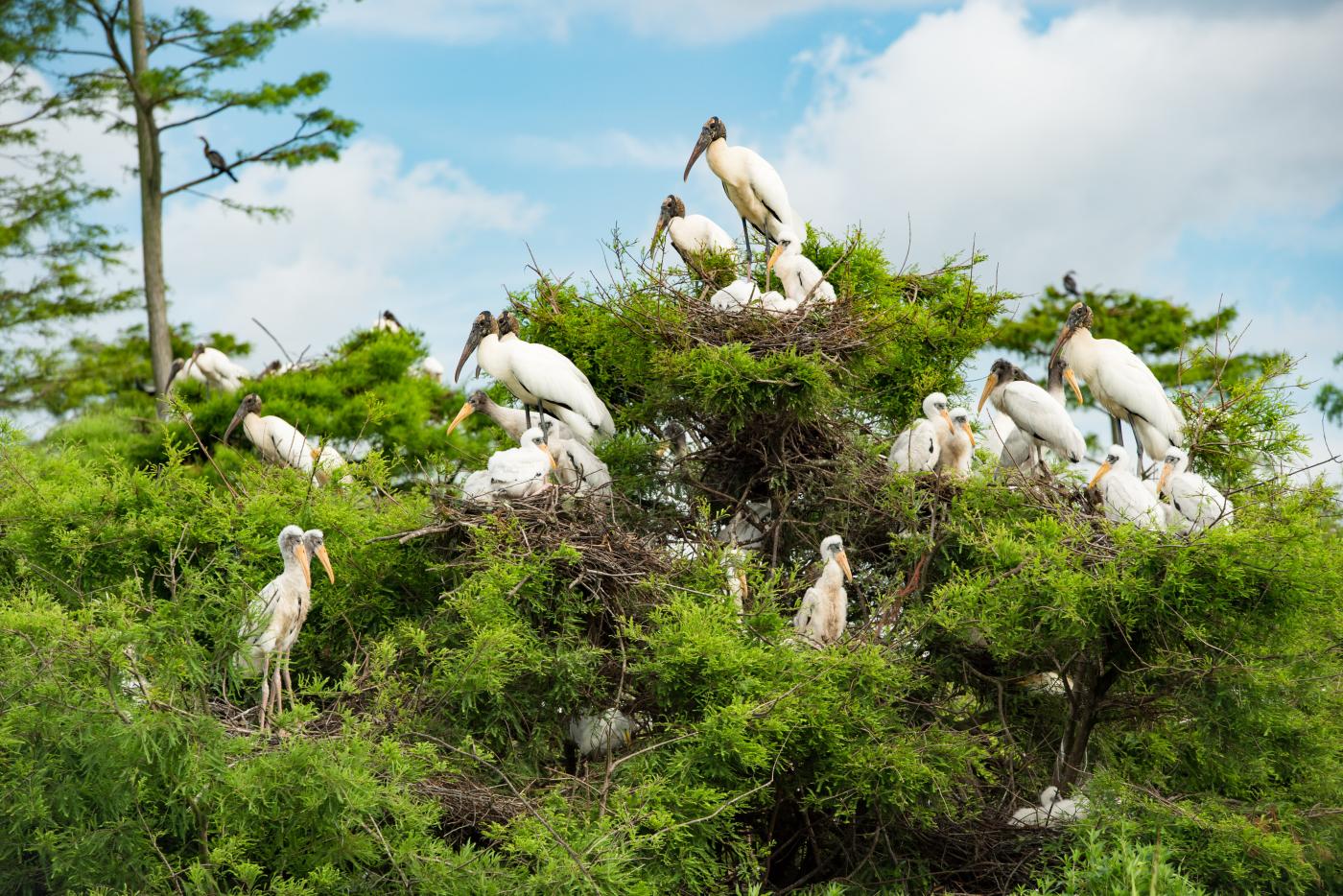
“I contributed data from our wood stork research to the study, and assisted with producing the manuscript,” said Schweitzer, the assistant chief of the Wildlife Diversity Program. “My colleague, Larry Bryan, with University of Georgia’s Savannah River Ecology Lab, and I tagged wood storks with transmitters that record locations and movement patterns, including altitude and speed. Data from these and additional wood storks will reveal their use of atmospheric conditions during migration as well as site selection and survival.”
In future work, the authors aim to build on their findings by measuring animals’ energy use directly, such as through heart rate monitoring. Doing so will capture differences in individual physiology, providing an even more realistic measure of the energetic cost of flight.
Publication:
Martina Scacco et al. (2026) Airflows redefine the cost of aerial transport in the wild | Science