
Special Regulations in CWD Surveillance and Management Areas
Attention Deer Hunters
Two Chronic Wasting Disease (CWD) Management Areas have been established for the 2026–27 hunting season. Each CWD Management Area contains counties where hunters have additional hunting opportunities to help manage the spread of CWD. One CWD Surveillance Area has been established for the 2026-27 hunting season. The Surveillance Area includes Edgecombe County (Primary), where CWD has been detected, as well as three adjacent counties (Secondary), where increased surveillance is occurring. It is recommended to not consume meat from a deer that tests positive for CWD, and CWD testing is available across the state.
Mandatory testing
During the 2026-27 deer hunting season there is no required mandatory sampling in the surveillance areas. Thanks to the support of hunters, Cervid Health Cooperators, and Commission staff, we exceeded CWD sampling goals by collecting more than 23,000 CWD samples during both the 2024-25 and 2025-26 hunting seasons. Voluntary CWD testing is available through drop-off freezers and Cervid Health Cooperators located across the state.
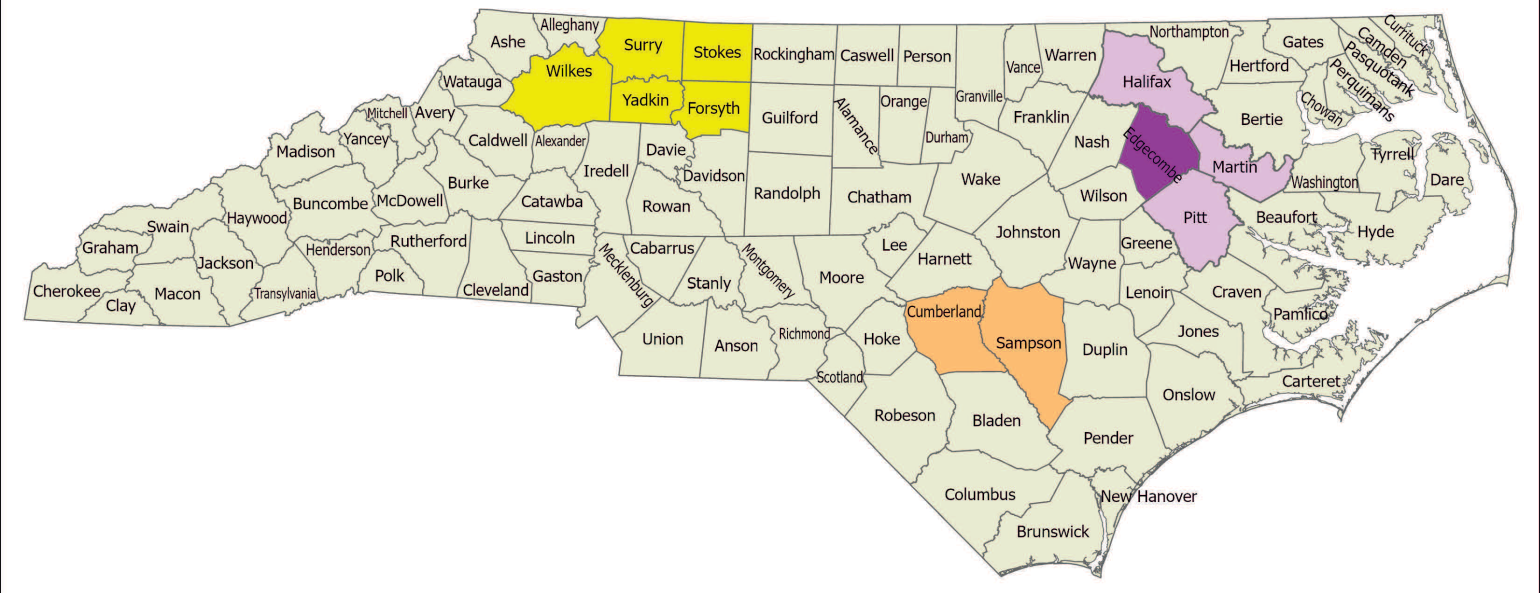
Map Legend
| Color | Area | Counties | Area Regulations |
|---|---|---|---|

| Northwest CWD Management Area | Forsyth, Stokes, Surry, Wilkes, Yadkin. No Mandatory Testing. | Restrictions on fawn rehabilitation, wildlife feeding & baiting, and attractants & scents. A Special Early Season is open in these counties in August and opening dates for blackpowder and gun seasons are earlier in some of these counties |

| Southeast CWD Management Area | Cumberland, Sampson. No Mandatory Testing. | Restrictions on fawn rehabilitation, wildlife feeding & baiting, and attractants & scents. A Special Early Season is open in these counties in August and opening dates for blackpowder and gun seasons are earlier in some of these counties |

| Primary CWD Surveillance Area | Edgecombe | Restrictions on fawn rehabilitation, wildlife feeding & baiting, and attractants & scents. |

| Secondary CWD Surveillance Areas | Halifax, Martin, Pitt. No Mandatory Testing. | Restrictions on fawn rehabilitation, wildlife feeding & baiting, and attractants & scents. |

| Non-surveillance Areas | All counties not listed above. No Mandatory Testing. | No further restrictions on fawn rehabilitation, wildlife feeding & baiting, or attractants & scents. |
Use of Natural Deer Attractants/Scents
No person shall possess or use any substance or material that contains or is labeled as containing any excretion collected from a cervid, including feces, urine, blood, gland oil, or other bodily fluid for the purposes of taking or attempting to take, attracting, or scouting wildlife in a surveillance area or CWD management area. Natural substances collected by a hunter from a cervid legally harvested in North Carolina may NOT be used or possessed in these areas. This prohibition shall not apply to the following substances:
- Synthetic products that are labeled as such.
- Natural deer urine and other substances collected from a facility in North Carolina with a valid Farmed Cervid License from the North Carolina Department of Agriculture and Consumer Services (NCDA&CS) and identified/labeled as such.
- Products labeled as participating in the Responsible Hunting Scent Association’s Deer Protection Program.
Properly Dispose or CWD Grows!
Carcass Disposal Restrictions: The final disposition (either directly by a hunter or indirectly when hunters use a processor, taxidermist, or trash service) of non-edible portions of cervid carcasses and carcass parts originating from North Carolina shall be in one of the following methods:
- in a lined landfill
- buried 3 feet below ground and 300 feet from a waterbody; or
- lawfully left on the ground within the county of origin.
It is the responsibility of hunters, taxidermists, and processors to properly dispose of deer carcasses after harvest in a safe and responsible manner. Follow cervid carcass disposal restrictions and carcass parts disposal and importation restrictions and never dispose of animal carcasses in water, on roadsides, in waterways, or on other’s property without permission.
Wildlife Feeding
The placement of minerals or salt to purposely congregate wildlife is prohibited in surveillance areas and CWD management areas. The placement of bait, food, or food products to purposefully congregate wildlife is prohibited from Jan. 2 – Aug. 31 in surveillance areas and CWD management areas, except for:
- Bird feeders
- Hunting in urban archery seasons in participating municipalities
- Other activities specifically permitted by the Wildlife Commission
*NOTE: Baiting deer is legal in Surveillance Areas and and CWD Management Areas from Sept. 1–Jan. 1.
Fawn Rehabilitation
All fawn rehabilitation within surveillance areas and CWD management areas is prohibited. Fawns may not be transported out of surveillance and CWD management areas and cannot be accepted by fawn rehabilitators.
(CWDMAP) Chronic Wasting Disease Management Assistance Program
This voluntary program provides hunters with additional deer tags to assist with management and surveillance of CWD on properties within a CWD Management Area, newly identified CWD positive counties, and areas near a known positive CWD deer as determined by District Biologist. Individuals or entities who own, lease, or control exclusive hunting rights on the property may apply. There are no acreage limits for application.