
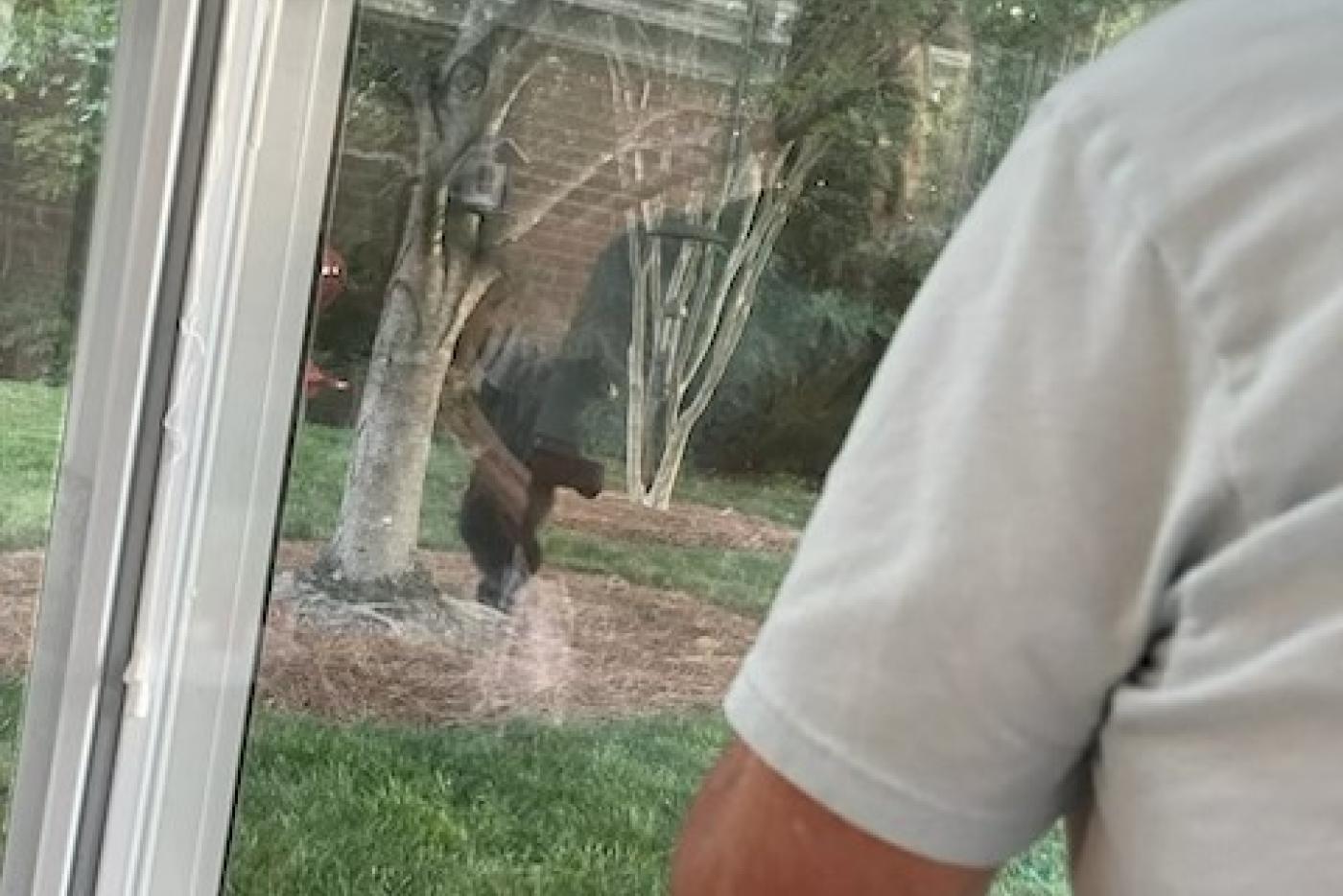
The N.C. Wildlife Resources Commission (NCWRC) has received a report from a Charlotte resident with video of a black bear eating from a bird feeder in the Highland Creek neighborhood.
NCWRC’s Wildlife Helpline was contacted today about the bear sighting that occurred last night around 7:30. NCWRC says this is normal behavior this time of year, as bear activity and movements increase. Black bears can be spotted in unlikely or unusual places in the spring and early summer, but this is no cause for alarm. Juvenile males, in particular, travel throughout the state seasonally or as they search for their own territory, including Mecklenburg County. Reports of bear sightings in the Piedmont spike from Memorial Day weekend through early summer.
According to NCWRC Black Bear Biologist Jenna Malzahn, transient bears have been observed in every county in North Carolina, including our larger cities.
“Historically, black bears were abundant throughout the state, including the Piedmont region,” said Malzahn. “The Piedmont region currently supports a very low density of bears, with most being transient. But thanks to conservation efforts, the expansion of the bear range means that dispersing bears may be spotted in new areas.”
Resident bear populations have been slowly expanding throughout the state. NCWRC maintains an occupied range map, illustrating confirmed reports of breeding female bears. NCWRC relies on harvest and mortality reports as well as public reports of bear sightings to document bears in the Piedmont. Currently, most Piedmont black bears are primarily found on the fringes of established mountain and coastal bear ranges, as well as bears crossing over the Virginia state line.
“A bear traveling to or through a highly populated area, even a place like Charlotte, is not an emergency,” said District Biologist Rupert Medford. “The best thing you can do is leave it alone, do not approach the bear, and let it travel on through.”
“Bears are just biologically doing what they do,” said District Biologist Dr. Joe Folta, who responded to a report earlier this year of a black bear roaming through a Durham subdivision. “The bear sighted in Durham disappeared as quickly as it appeared, which is often the case if they don’t find an easy source of food.”
NCWRC advises the public to become familiar with BearWise®, and use the BearWise Basics as a resource, which minimizes conflicts with bears and offers guidance that encourages a transient bear to move on rather than remain in an unwanted area.
BearWise Basics include:
• Never feed or approach a bear.
• Secure food, garbage and recycling.
• Remove bird feeders when bears are active.
• Never leave pet food outdoors and keep dogs leashed.
• Clean and store grills.
• Inform your neighbors.
“Since adopting the BearWise program in 2018, we’ve had promising results with encouraging folks in the mountain communities to follow BearWise recommendations,” said Ashley Hobbs, the agency’s Statewide BearWise Coordinator. “Most people in Western North Carolina have at least heard of BearWise, and many use it as a resource to successfully coexist with bears. It’s better to be proactive than reactive when it comes to wildlife encounters, thus we want BearWise to become familiar to the rest of the state. Urban expansion will mean more bear encounters. We want safety for both humans and bears, and we know BearWise provides the tools to make it happen.”
Learning about the BearWise Basics is important for those living in the Piedmont, and for those travelling to other parts of the state.
“BearWise doesn’t just provide information for living alongside bears in residential areas. It also offers advice for vacationing in bear country,” explains Hobbs. “In North Carolina, you’re just as likely to encounter a bear at the beach as you are in the mountains.”
Hobbs suggests brushing up on reminders when planning summer vacations, such as how to store food and garbage, slow down when driving and what to do during a bear encounter. A bear sighting on vacation can be an un-bear-ably memorable experience, especially when you are prepared.
For more information visit:
BearWise.org
NCWRC Bear Species Page