
Landowner Protection Act
North Carolina's Landowner Protection Act
The Landowner Protection Act provides two ways for landholders to post their lands to allow only hunters, trappers and anglers with written permission to legally enter their property:
The landholder places notices, signs, or posters on the property boundaries at a distance of 200 yards apart or closer.
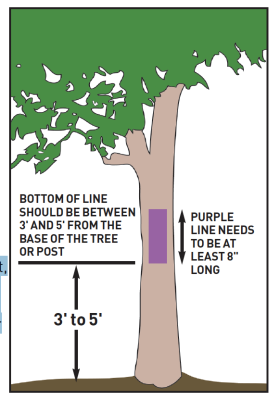
- The landholder posts their property is with purple paint. The landholder can paint a vertical line of purple paint on trees or posts around property boundary, or areas intended to prohibit trespass. The paint line needs to be at least 8" long and the bottom of the line should be between 3' and 5' from the base of the tree or post. The paint marks need to be placed 100 yards apart or closer.
Sportsmen need written permission, dated within the past 12 months, signed by the landowner or lessee, to hunt, fish, or trap on lands postedwith signs or purple paint. You must carry written permission on your person. If a hunting club has leased the land, hunters must have a copy of their hunting club membership and a copy of the landowner permission given to that club.Wildlife officers will enforce the Landowner Protection Act.
The Landowner Protection Act does not change general trespass laws nor have any effect on landswhich are not posted. It does not repeal any local acts currently in effect that require written permission to hunt, fish or trap.
North Carolina law encourages owners of land tomake property available for recreational use. The lawstates that a landowner who allows someone, without charge, onto their land for recreational purposes owes them the same duty of care they would owe a trespasser.
Landowner Protection Act Frequently Asked Questions
The Landowner Protection Act (H762) clarifies existing trespass laws, for the purposes of hunting, fishing, and trapping, to specify the requirements for written permission on posted land only. The new law is effective October 1, 2011.
The Landowner Protection Act addresses existing trespass law to strengthen and clarify four elements:
- Defines the requirements for written permission to hunt, fish, or trap on posted lands.
- Allows landowners to post land using purple paint marks or by placing signs or posters, as currently allowed.
- Allows Wildlife Officers to enforce trespass laws on site, instead of executing process issued by the courts.
- Removes the exemption for Halifax and Warren counties that requires landowners to initiate prosecution for trespass on posted lands.
The Landowner Protection Act specifically relates only to hunting, fishing, or trapping on posted lands. It clarifies the existing G.S. 14-159.6 requirement for written consent to hunt, fish, or trap on posted lands by specifying that written permission, dated within the past 12 months and signed by the landowner, lessee, or agent of that land, be carried and displayed upon request of any law enforcement officer. If a hunting club has leased the land, a person shall have a copy of their hunting club membership and a copy of the landowner permission granted to that hunting club.
The Landowner Protection Act does not change general trespass laws nor have any effect on lands which are not posted. It does not repeal any local acts currently in effect that require written permission to hunt, fish, or trap.
Landowners in North Carolina who want to post their lands can have difficulty keeping posted signs erected and intact. Using paint marks, as an alternative or in addition to signage, is a convenient and effective means of marking lands as posted, and requires less frequent maintenance and cost, since paint marks are more difficult to vandalize than signs.
Many states throughout the U.S. currently allow the use of paint marks to denote land posting. Landowners in N.C. now may use signs, purple paint marks or both to post their properties.
Each paint mark must be a vertical line of at least eight inches in length, and the bottom of the mark shall be no less than three feet or more than five feet from the base of the tree or post. For more information, including an illustration, on how to post property under the new law, see the Landowner Protection Act document on our website.
Prior to passage of the Landowner Protection Act, Wildlife Officers were generally required to execute process in order to enforce trespass under G.S. 14-159.10. This means a Wildlife Officer would obtain an arrest warrant or criminal summons prior to enforcing trespass.
Beginning October 1, 2011 the Landowner Protection Act makes changes that enable Wildlife Officers to write a citation on site, removing the barrier to proper and efficient enforcement of the existing trespass law.
Chapter 38A of the North Carolina General Statues specifically encourages landowners to make lands available for recreational use at no cost. General Statute 38A-4 states that a landowner who permits or invites someone, without charge, onto their land for recreational purposes owes them the same duty of care they would owe a trespasser.
There is no change or repeal of local permission laws under the Landowner Protection Act.
Under the Landowner Protection Act, either the landowner or leaseholder may grant permission to the property.
The hunting club must have written permission from the landowner or leaseholder and each individual must carry both a current membership card from the hunting club and a copy of the written permission granted to the club.
You are required by the new law to carry valid proof of membership in the hunt club and a copy of the club’s written permission to hunt on the landowner or leaseholder’s posted property.
To comply with the written permission requirements of the Landowner Protection Act, you may use any form that provides at least the following information:
- Landowner or leaseholder’s name
- Sportsman’s name
- Dated within the last 12 months