
The N.C. Wildlife Resources Commission (NCWRC) has affirmed Chronic Wasting Disease (CWD) primary and secondary surveillance areas for North Carolina’s 2026-27 deer hunting season, effective May 1. A proclamation signed April 27, 2026 includes Edgecombe, Martin, Pitt and Halifax counties as the state’s surveillance areas, and removes 11 from the list.
“Thirty-three deer tested positive for CWD during the 2025-26 hunting season, bringing the total number of deer that have tested positive to 67 since it was first discovered in North Carolina in 2022,” said Deer Biologist April Boggs Pope. “Four of the positive deer were found in Edgecombe County during the 2025-26 deer hunting season, making it necessary for NCWRC to proclaim Edgecombe as a primary surveillance area and Martin, Pitt and Halifax counties as secondary surveillance areas.”
After several years of intensive surveillance, CWD has not yet been found in Alexander, Alleghany, Ashe, Bladen, Davie, Guilford, Iredell, Harnett, Hoke, Rockingham or Robeson counties. These counties no longer need to be proclaimed as secondary surveillance areas, but we will continue sampling in these areas and across the state.
Cumberland, Forsyth, Sampson, Stokes, Surry, Wilkes and Yadkin counties are not listed in the proclamation, but they have been established as CWD Management Areas through the normal rulemaking process due to the presence of deer infected with CWD. Hunters in these counties will have some additional hunting opportunities this fall with a special early season in late August and, in some counties, an earlier opening day for firearms season.
There are no dates during the 2026-27 deer hunting season when hunters will be required to submit a sample for CWD testing, however voluntary testing will remain an option for hunters across the state. Testing is recommended in CWD Management Areas and primary surveillance areas before consuming venison from deer harvested in these areas, and it is recommended to not eat a deer that tests positive for CWD.
"With the number of positive deer remaining relatively low, we can still make a difference and slow the spread of CWD in North Carolina by continuing to test for CWD, increasing participation in the CWD Management Assistance Program, and following new regulations regarding disposal of deer carcasses,” said Boggs Pope.
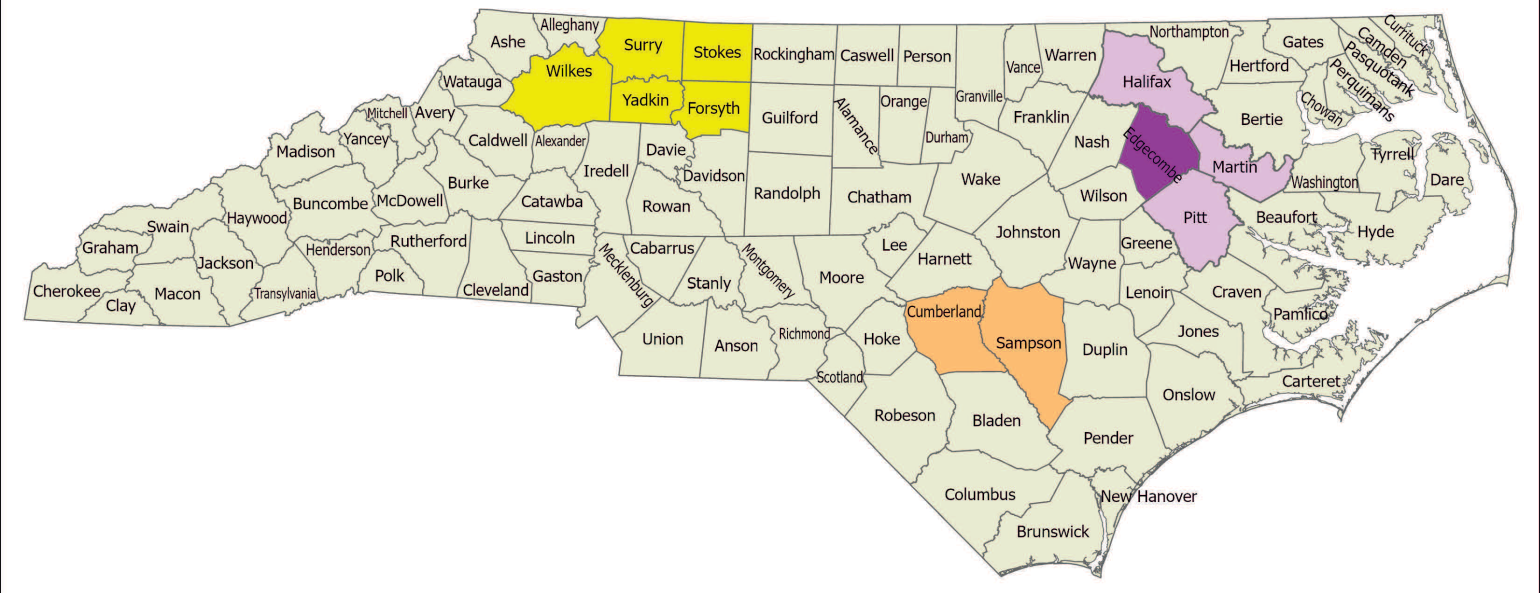
Map Legend
| Color | Area | Counties | Area Regulations |
|---|---|---|---|

| CWD Management Areas | Cumberland, Forsyth, Sampson, Stokes, Surry, Wilkes, Yadkin. No Mandatory Testing. | Restrictions on fawn rehabilitation, wildlife feeding & baiting, and attractants & scents. |

| CWD Surveillance Areas | Edgecombe, Halifax, Martin, Pitt. No Mandatory Testing. | Restrictions on fawn rehabilitation, wildlife feeding & baiting, and attractants & scents. |

| Non-surveillance Areas | All counties not listed above. No Mandatory Testing. | No further restrictions on fawn rehabilitation, wildlife feeding & baiting, or attractants & scents. |
“Thanks to the support of hunters, Cervid Health Cooperators, and Commission staff, we exceeded CWD sampling goals by collecting more than 23,000 CWD samples during the 2025-26 hunting season, making it once again unnecessary to require mandatory sampling in the surveillance areas during the 2026-27 deer hunting season,” Boggs Pope explained. “Our Cervid Health Cooperator program, combined with voluntary submissions from hunters, is providing the level of surveillance currently needed. Continued voluntary testing will allow us to monitor CWD within the state and allow hunters the option to have their deer tested.”
NCWRC reminds the public that, within surveillance areas and CWD Management Area counties, it continues to be illegal to:
- Rehabilitate fawns or transport them for rehabilitation. CWD can easily spread to new areas whenever infected deer are transported by people. Fawns can be infected with CWD by their mother even before birth and not show any visible signs of illness until the late stages of disease.
- Place new salt or minerals in existing mineral lick sites or to establish new mineral lick sites. Soil and vegetation surrounding mineral sites can be contaminated by feces, urine and saliva that contains infectious CWD prions. Once CWD prions are present in the environment, they are practically impossible to remove or destroy.
- Put out bait, food or food products to purposefully congregate wildlife from Jan. 2 through Aug. 31 of each year. Artificially congregating wildlife increases the risk of disease transmission.
“We are looking forward to improving disease management in our new CWD Management Areas. By providing new opportunities for hunters via the special early season and earlier opening day for firearms season we’re hoping to keep CWD prevalence low while maintaining opportunities for hunters,” said Wildlife Health Biologist Miranda Turner. “We’ve adapted our CWD regulations by removing in-state carcass transportation restrictions and have transitioned to requiring proper disposal of non-edible carcass parts. Starting this fall, non-edible carcass parts must be buried, left in the county of harvest, or taken to a landfill/placed in household trash. We hope this shift will balance giving hunters maximum flexibility to harvest deer where they want across the state while limiting potential spread of CWD.”
All regulations related to CWD will be published in the 2026-27 Inland Fishing, Hunting and Trapping Regulations Digest in August and posted on ncwildlife.gov/CWD.
Learn more about CWD in North Carolina.