
Proposals will be evaluated by relevant biological staff and recommended for funding based on project design, available funding, estimated time to completion, applicant experience, and alignment with agency research priorities.
Proposal should be typed in 11-point font size and should include all required information as listed below. Information provided by NCWRC in the Request For Proposal may be used in the proposal language. Items 1-10 should not exceed 7 pages total, and completed proposal should not exceed 15 pages.
Questions may be addressed to Jeremy McCargo.
Required Information for Full Proposal:
- Title Page (title of project, name and contact information for lead personnel)
- Executive Summary
- Project Need Definition
- Background that addresses project need and proven efficacy of planned methodologies. Include citations.
- Project Objectives and Tasks
- Methods, including study area and/or lab facility
- Anticipated Deliverables/Products
- Anticipated Benefits
- Potential Risks (to schedule, personnel, local ecosystem, etc.)
- Concurrent Commitments
- Budget and Budget narrative. Detail any work that will be subcontracted.
- Proposed project schedule
- Personnel biographies (education, relevant experience, etc.); subcontractors should be included in this list. A list of relevant completed projects may also be included. Do not include full resumes and do not exceed ½ page per person.
- Appropriate federal and state permits, including endangered species recovery permits if applicable, held or applied for.
Proposal should be submitted as a single PDF file to research@ncwildlife.gov. Deadline for submission is December 31, 2025.
North Carolina Wildlife Resources Commission
Request for Proposal
Research Title: Understanding Striped Bass Recruitment Limitations in North Carolina Coastal Rivers.
Specific Problem or Research Need
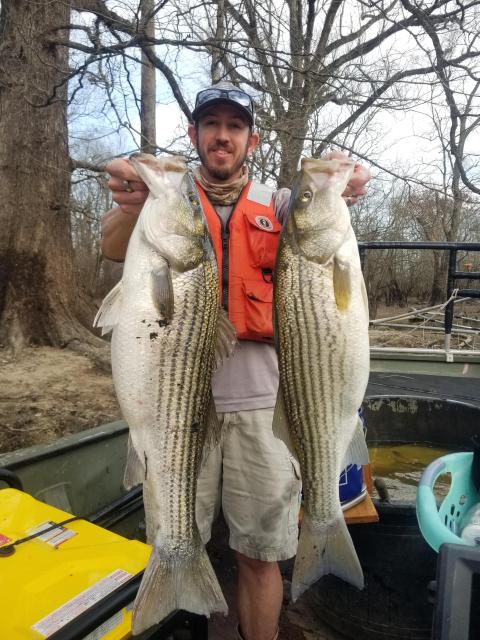
Striped Bass Morone saxatilis populations in the Roanoke, Tar, Neuse, and Cape Fear rivers are overfished and below historical abundance levels despite restoration restocking efforts and harvest closures. In addition to high mortality caused by overfishing, limited recruitment is occurring in Striped Bass stocks in North Carolina’s coastal river systems. There remains a need to identify the processes that are causing recruitment bottlenecks in each river system to provide information for better management of these important populations.
Background
The Central Southern Management Area (CSMA) has been stocked with Striped Bass since the 1980s. Despite these efforts, the recovery goal of self-sustaining populations has yet to be achieved. Recent management actions, including closing harvest in 2019, have addressed the fishing mortality concerns that have led to recruitment overfishing, but recruitment has yet to be documented at a level that could lead to recovery. Initial hatchery evaluation with OTC suggested that Striped Bass stockings contributed minimally to the CSMA stocks. After the parentage-based tagging (PBT) program began in 2010, it was observed that 90–100% of the population was hatchery fish. Furthermore, spawning and non-spawning "contingents" have been observed in Neuse and Cape Fear River telemetry studies. Bradley et al. (2018) found only about 55% of adult Striped Bass made a spawning migration (2014 & 2015 combined). Similarly, NCDMF found only 47% of Cape Fear River Striped Bass made a spawning migration (and some of those went up a different river). It is not known when Striped Bass imprint, but if imprinting occurs before the size/age they are stocked, hatchery-produced adults may not make a spawning migration and therefore, would be less likely to contribute to population recovery. Additional time to allow for a fully developed age structure (ages exceeding 12+) in the populations may be necessary, but there is concern that the impacts of stocking have changed the population and/or the current stocking plan is simply maintaining fish on the landscape without meeting recovery goals. Since stockings have been occurring for over 40 years, it is important to document the impacts of long-term stockings and determine if there is a better stocking plan that could lead to enhanced recruitment and population recovery.
Organic chemicals (OC) possessing fluorinated-carbon molecules (e.g. PFAS) have been documented in coastal systems and their interference with biological processes is becoming more widely known. OCs have the potential to interfere with early life stages of larval Striped Bass by being passed maternally via ovaries and subsequently disrupting metabolic processes. The North Carolina Wildlife Resources Commission conducted preliminary research in 2023 to determine if maternal transfer of OCs was occurring in coastal river Striped Bass. Striped Bass ovary samples were collected from Roanoke River (n=10), Tar River (n=10), Neuse River (n=10), Cape Fear River (n=10), and Watha State Fish Hatchery (n=5; control) in spring 2023. Ovary samples were tested for various OCs by Pace Labs in Green Bay, Wisconsin. The Striped Bass ovaries from each study area tested positive for a variety of OCs with the most abundant being Perfluorooctanesulfonic acid (PFOS). These results suggested that maternal transfer is likely occurring. We are interested in determining if contaminants like PFOS and/or other OCs are disrupting the early life history of Striped Bass in North Carolina coastal river systems resulting in early life mortality and are, therefore, limiting factors for successful recruitment.
Required Permits
A scientific fish collection license must be acquired prior to beginning any collections of eggs, larvae, juveniles, or adult Striped Bass.
Anticipated Deliverables
- Quarterly progress reports (QPR), at the completion of each quarter
- Final report
- Final presentation
- All raw data collected
Anticipated benefits
Results from this project will lead to an increased understanding of recruitment and population recovery of Striped Bass in North Carolina’s coastal rivers. If OCs are shown to impact recruitment, we will have a better understanding of population restoration limitations. Additionally, changes could be made to the current stocking strategy if long-term stocking of phase-II fish is shown to have negative impacts on recovery. Results from this study also could be applied to the Roanoke River-Albemarle Sound Striped Bass population since we began supplemental stockings for that population in 2023.
Anticipated timeline:
Entire project: July 2026 - June 2029
Field work: March 2027 - June 2028
Budget:
A 25% match is required.
References
Bradley, C. E., J. A. Rice, D. D. Aday, J. E. Hightower, J. Rock, and K. L. Lincoln. (2018) Juvenile and adult Striped Bass mortality and distribution in an unrecovered coastal population. North American Journal of Fisheries Management 38:104–119.