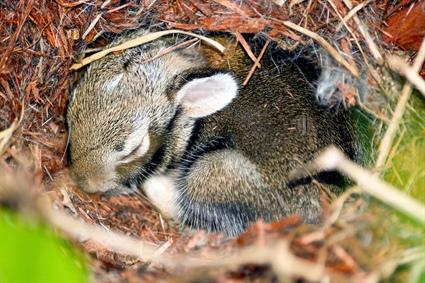
Eastern Cottontail Rabbit

Scientific Name: Sylvilagus floridanus
Classification: Game
Photo Credits: Melissa McGaw
Avid Upland Gamebird and Rabbit Hunter Survey
Appearance
- Brown fur on the upper part of the body with a fuzzy white cotton ball-like tail. Often has a white spot on the forehead.
- The eastern cottontail rabbit is one of three species of rabbits native to North Carolina. The other two species are the marsh rabbit, which has a dark, bluish-gray color on the underside of the tail, and the Appalachian cottontail rabbit, which can be hard to distinguish from an Eastern, but is smaller and often has a black spot between its ears.
Diet
- Herbaceous plants, but will also feed on grains and the inner bark of shrubs and saplings.
Habitat and Habits
- Well-known and most widely distributed rabbit in North Carolina.
- Well adapted to living near humans. Yards provide adequate habitat, food, and cover.
- Rabbits are most active in early morning, late afternoon, or at night.
Eastern Cottontail Species Profile
Regulations
The eastern cottontail is classified as a small game species with a hunting season and bag limits.
Have a Wildlife Problem?
Rabbit Hemorrhagic Disease Virus (RHDV-2) is a highly contagious and often fatal calicivirus that affects the rabbit species. Although the disease is currently found throughout the western U.S. in native cottontail species and not in North Carolina, the North Carolina Wildlife Resources Commission is working under the assumption that the virus will eventually make its way to the state. Read "RHDV2 Recommendations for Hunters and Trappers While Handling and Consuming Rabbits" handout. Found a dead rabbit? Please call the HWI helpline to report and have someone come to collect.
Found a Nest?
Rabbits build their nests in low, dense vegetation, and are often discovered by unsuspecting homeowners when gardening or mowing the lawn. If you find a nest and there is no adult nearby, don’t worry - this is normal. Female rabbits only visit the nest to
feed their young a few times a day and will avoid drawing any attention to their location when people or other potential predators are nearby. If the young are undisturbed, it is best to leave the nest alone as you found it. Baby rabbits that are unharmed but outside the nest can be gently put back and the vegetation pressed into place to cover them. It can help to run your hands in dirt first to prevent leaving human scent around the nest, which may attract predators. If one or more of the young rabbits are obviously injured, contact a licensed small mammal rehabilitator. If you suspect the nest has been or will be abandoned, place twigs or fresh blades of grass over the opening in a tic-tac-toe pattern. Check back in 24 hours, and if the twigs have not been disturbed, contact a rehabilitator.
Found a Baby Rabbit?
Young rabbits found outside the nest that are larger than 4 inches long and able to hop around freely are independent juveniles and do not need assistance. Young rabbits that are smaller than 4 inches and are relatively immobile are still under the care of their mother and should be returned to the nest, if possible. For young that are visibly injured or cannot be returned to the nest, contact a licensed small mammal rehabilitator for assistance.